Short answer: From a plain cut-metal key to a push-to-start proximity fob, replacement prices swing enormously depending on the technology inside. Here is what each type really involves and where an automotive locksmith fits alongside the dealership.
From a plain cut-metal key to a push-to-start proximity fob, replacement prices swing enormously depending on the technology inside. Here is what each type really involves and where an automotive locksmith fits alongside the dealership.
Most of the sticker shock around car keys comes from not knowing which type you actually have. The simplest is a mechanical key: just cut metal, no electronics, common on older vehicles, and often the cheapest to duplicate. Next is the transponder key, which hides a chip that must be electronically programmed to your specific car before the engine will start, so you are paying for both cutting and programming, commonly landing in the range of roughly $120 to $250 depending on the make. Then there are remote-head and flip keys that combine a transponder with the lock/unlock buttons in one unit, which pushes the part cost higher. At the top sit smart proximity fobs, the push-button-start kind you never take out of your pocket; these are the most expensive to replace, frequently in the several-hundred-dollar range and sometimes more on luxury or newer models, because the fob itself is costly and the programming is more involved. Knowing your category is the difference between expecting a small bill and bracing for a large one.
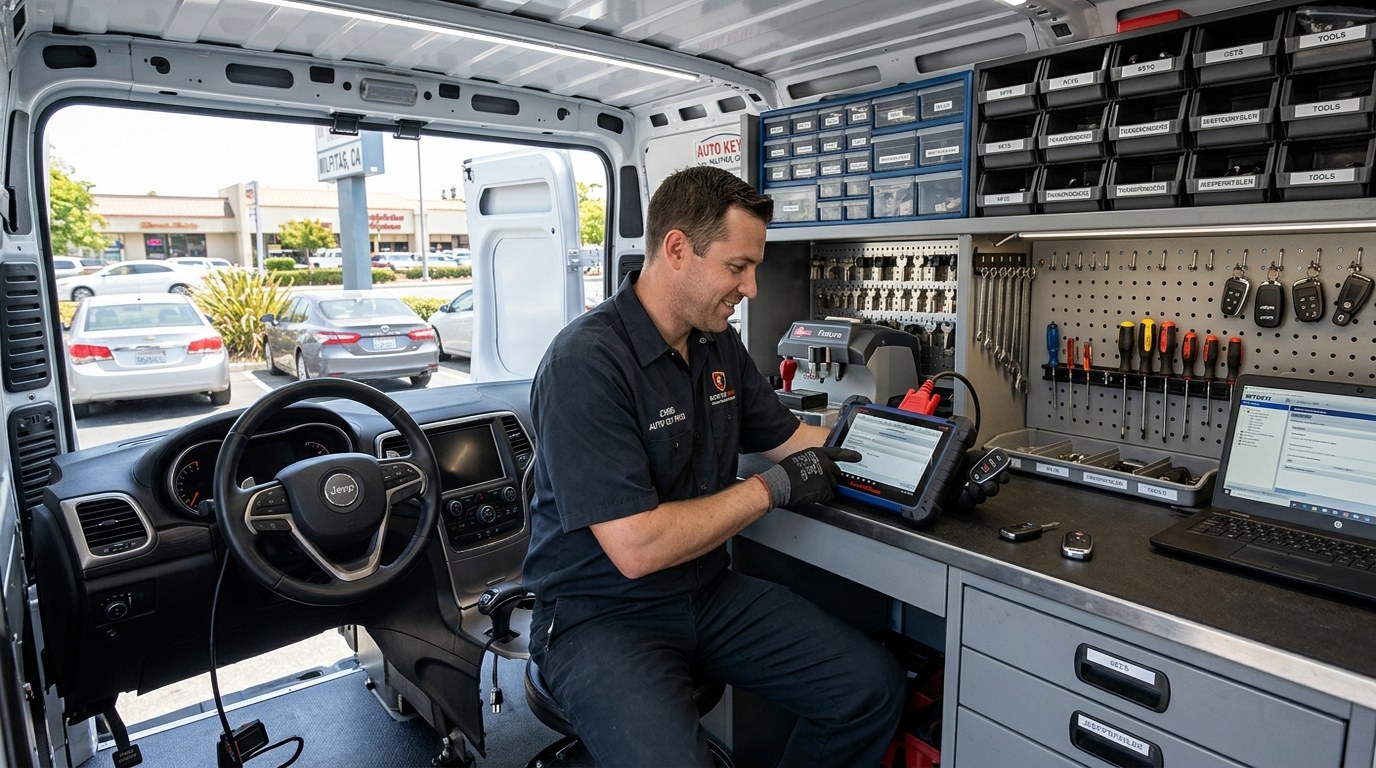
For many mainstream vehicles, a mobile automotive locksmith can cut and program a working key or fob for less than a dealership would charge, and can usually come to you rather than requiring a tow, which matters a great deal if you have lost your only key and the car will not move. The dealership's advantage shows up at the edges: certain very new models, high-security manufacturer systems, or situations where the vehicle's key data must be pulled from the manufacturer can require dealer tools or dealer access. The honest guidance is to call an automotive locksmith first with your year, make, and model and simply ask, 'Can you handle this vehicle, and what is the realistic total?' If they can, you often save time and money; if they cannot, a good one will tell you plainly that this is a dealer job rather than leaving you stranded after a failed attempt.
The single biggest money-saver is timing that is entirely in your control: have a spare made while you still have a working key. Programming a duplicate when the car already recognizes an existing key is generally faster and cheaper than an 'all keys lost' situation, where the system has to be reset from scratch. Keep proof that the car is yours and have your VIN handy, since a legitimate locksmith will ask for identification and ownership before programming a key, and that is a sign they are doing the job properly, not a hassle to avoid. Finally, ask up front whether the quote includes both cutting and programming and whether it covers the physical key or fob shell, because those are the pieces that most often turn a low-sounding estimate into a higher final bill. As with any locksmith work, treat the number you are given as a hedged range that depends on your specific vehicle, not a guarantee.
Most of the sticker shock around car keys comes from not knowing which type you actually have. The simplest is a mechanical key: just cut metal, no electronics, common on older vehicles, and often the cheapest to duplicate. Next is the transponder key, which hides a chip that must be electronically programmed to your specific car before the engine will start, so you are paying for both cutting and programming, commonly landing in the range of roughly $120 to $250 depending on the make. Then there are remote-head and flip keys that combine a transponder with the lock/unlock buttons in one unit, which pushes the part cost higher. At the top sit smart proximity fobs, the push-button-start kind you never take out of your pocket; these are the most expensive to replace, frequently in the several-hundred-dollar range and sometimes more on luxury or newer models, because the fob itself is costly and the programming is more involved. Knowing your category is the difference between expecting a small bill and bracing for a large one.
For many mainstream vehicles, a mobile automotive locksmith can cut and program a working key or fob for less than a dealership would charge, and can usually come to you rather than requiring a tow, which matters a great deal if you have lost your only key and the car will not move. The dealership's advantage shows up at the edges: certain very new models, high-security manufacturer systems, or situations where the vehicle's key data must be pulled from the manufacturer can require dealer tools or dealer access. The honest guidance is to call an automotive locksmith first with your year, make, and model and simply ask, 'Can you handle this vehicle, and what is the realistic total?' If they can, you often save time and money; if they cannot, a good one will tell you plainly that this is a dealer job rather than leaving you stranded after a failed attempt.
The single biggest money-saver is timing that is entirely in your control: have a spare made while you still have a working key. Programming a duplicate when the car already recognizes an existing key is generally faster and cheaper than an 'all keys lost' situation, where the system has to be reset from scratch. Keep proof that the car is yours and have your VIN handy, since a legitimate locksmith will ask for identification and ownership before programming a key, and that is a sign they are doing the job properly, not a hassle to avoid. Finally, ask up front whether the quote includes both cutting and programming and whether it covers the physical key or fob shell, because those are the pieces that most often turn a low-sounding estimate into a higher final bill. As with any locksmith work, treat the number you are given as a hedged range that depends on your specific vehicle, not a guarantee.
Call (408) 791-0007 and describe the situation, your exact location, and what you need. Timing is confirmed on that call rather than promised in advance.
Call for help: (408) 791-0007 — a straight answer and an honest estimate before any work begins.